Gosforth in World War II
Bombs on Matthew Bank, an anti-aircraft bunker at Melton Park, evacuated children, and a community at war. Gosforth's largely forgotten wartime story.
Gosforth in the 1940s was a very different place, a suburban community caught up in a global conflict, dealing with air raids, evacuation, rationing, and the constant anxiety of a city at war. The physical scars have long since healed, but the stories survive. Here's what happened in Gosforth during World War II.
The Bombing of Matthew Bank
Gosforth suffered its most devastating wartime incident when ten high-explosive bombs were dropped on the Matthew Bank area. Houses were destroyed and many more damaged in Matthew Bank and Keyes Gardens. According to an eyewitness account recorded in 1991, seven people died and a number were seriously injured.
One remarkable survival story emerged from the rubble. A young boy called Newton Shipley was found hanging upside down by his foot in one of the bombed houses. His foot had to be amputated to free him, but he made a full recovery and was awarded the Scouts VC badge for bravery, an extraordinary act of courage from a child pulled from the wreckage of his own home.
The Newcastle Blitz of 1941 hit the city centre and riverside hardest, but the Gosforth bombs were a reminder that nowhere was truly safe. Air raid shelters, blackout curtains, and the wail of sirens became part of daily life.
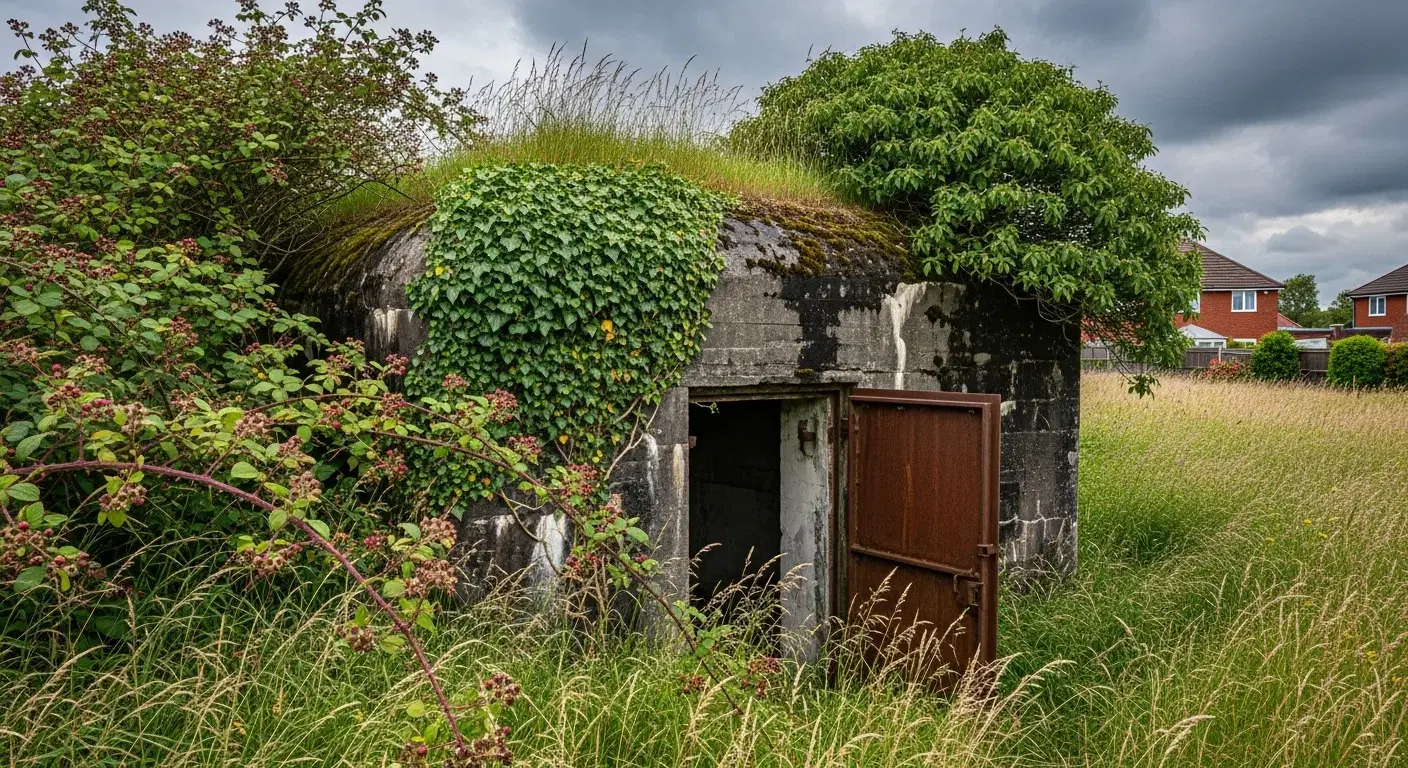
The Anti-Aircraft Operations Room at Melton Park
What is now the quiet residential estate of Melton Park had a secret wartime role. Low Gosforth House, a Victorian mansion on the site, was requisitioned as an Anti-Aircraft Operations Room (AAOR), a regional command centre coordinating the heavy anti-aircraft batteries defending Tyneside from German bombers.
The house was hastily fortified with two pillboxes. After the war, remarkably, it kept going, remaining operational into the Cold War as the command centre for the anti-aircraft battery at Lizard Farm, Whitburn. In the early 1950s a purpose-built reinforced concrete bunker was constructed alongside the mansion to withstand potential Soviet attack. The site eventually became the Northumberland Record Office in 1962 before closing in 2007.
Read the full story in our Fascinating History of Melton Park.
Evacuation
Following the declaration of war in September 1939, over 30,000 people, mainly children. Were evacuated from Newcastle to safer areas including the Lake District and rural Northumberland. Gosforth families were directly affected, with children sent away from their parents to live with strangers in the countryside. For some, the experience was positive; for others, it was traumatic.
The evacuation was one of the defining experiences of the war for an entire generation of Gosforth children. Many didn't return home until 1944 or 1945, by which point they had spent formative years away from their families and communities.
The Home Front
Life in wartime Gosforth was shaped by rationing, blackouts, and the community war effort. Allotments sprang up on every available piece of land as families grew vegetables to supplement rations, the "Dig for Victory" campaign was taken seriously in a suburb with plenty of garden space.
Community organisations mobilised. Gosforth Central Ladies Bowling Club was awarded a certificate for services rendered in the making of hospital supplies during the war, one of many local groups that contributed to the home front effort through fundraising, bandage-making, and supporting wounded servicemen.
The Town Moor, which had served the community as common grazing land for centuries, took on additional wartime roles, including military training and anti-aircraft positions. The open ground that Gosforth residents had always used for recreation became part of the city's defence infrastructure.
What Remains
The physical evidence of Gosforth's wartime experience has largely disappeared. The bombed houses on Matthew Bank were rebuilt. The Melton Park bunker was demolished (though its archaeology was carefully recorded in 2009). The air raid shelters are gone.
But the stories survive, in family memories, in local archives, and in the quiet resilience of a community that endured bombing, evacuation, and years of uncertainty. Gosforth's wartime generation is almost entirely gone now, which makes recording and sharing these stories all the more important.
Sources: Discovering Heritage; Newcastle City Council wartime records; Tyne and Wear Archives; Co-Curate (Newcastle University); eyewitness accounts recorded 1991.
Never miss what’s on
Join the weekly Gosforth.org digest — the best events, news and local tips, straight to your inbox. Free, one email a week.
What's On
Haunted Shadows: The Gothic Tales of Edith Nesbit
Doors 7:00 PM · Gosforth Civic Theatre, Regent Farm Road, Gosforth, Newcastle upon Tyne, NE3 3HD
NHSN and 1829 Talks: Lessons from the Rainforest and Harvestmen of the North East
6:00 PM - 8:00 PM · Curtis Auditorium, Herschel Building, Newcastle University, Newcastle upon Tyne, NE1 7RU
Bark In The Park Raceday
See booking · Newcastle Racecourse, High Gosforth Park, Newcastle upon Tyne, NE3 5HP