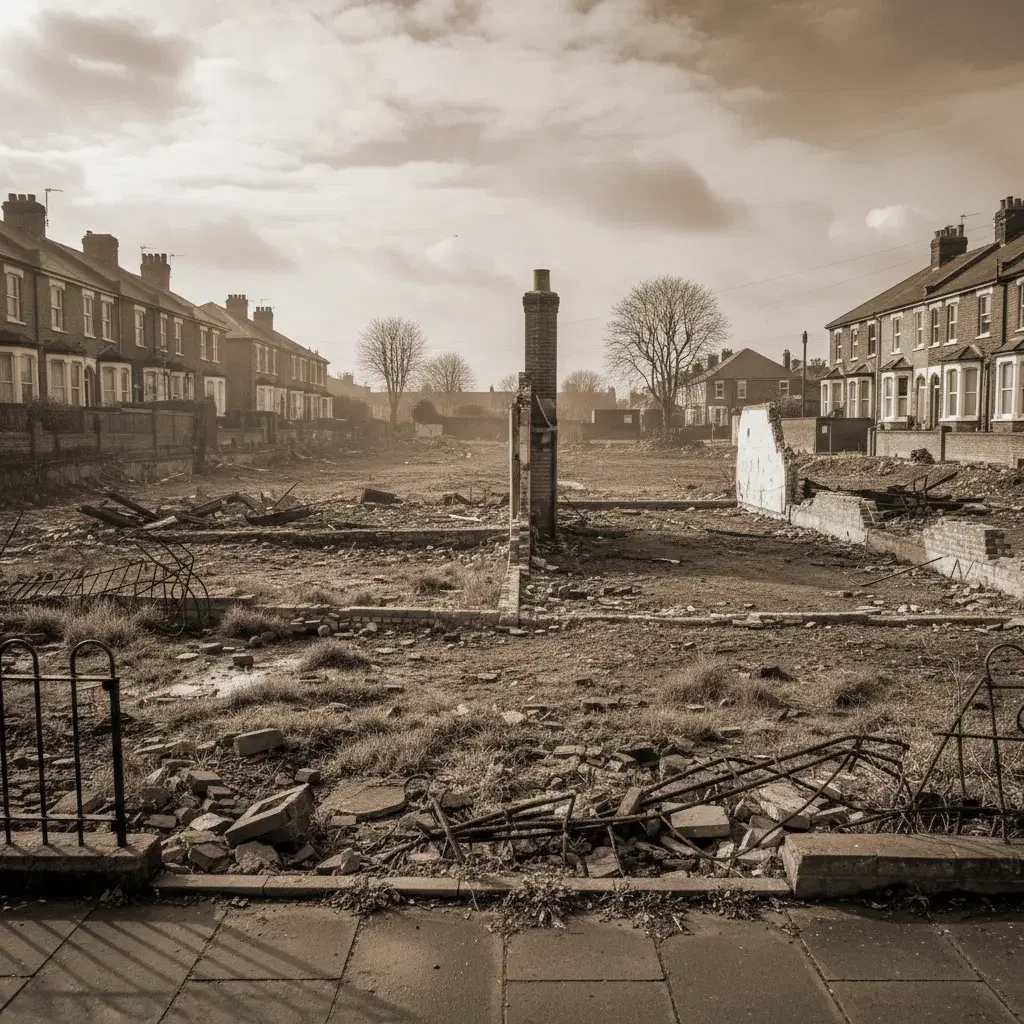
Lost Buildings of Gosforth
The Royalty Cinema, Coxlodge Hall, the greyhound stadium, and the tram sheds, the buildings that disappeared from Gosforth's streets.
Walk down Gosforth High Street today and it's hard to imagine what stood there before. A 1,384-seat art deco cinema. A tramway stable for 116 horses. A war memorial hall. A Victorian country house with 30 acres of grounds. All gone, replaced by supermarkets, retirement homes, and shopping precincts. Here are the buildings that Gosforth lost.
The Royalty Cinema
The Royalty opened on 17 October 1934 with a charity night featuring Roy Fox & His Band. Public screenings began the next day with Al Jolson in "Wonder Bar." Designed by Marshall & Tweedy, it was an up-market "super cinema" with a striking exterior of white and blue plasterwork, a glass dome lit with coloured lights inside, and colourful neon signage that made it a landmark on the A1.
The auditorium seated 1,384 across stalls and a circle, with a 40-foot-wide proscenium. For nearly 50 years it was the cultural heart of Gosforth's High Street. The last film screened on 30 December 1981, a Disney double bill of "Dumbo" and "The Incredible Journey."
The site was cleared and replaced by Homedowne House, a retirement housing complex of 41 flats built in 1985. Memories and photographs are collected at royaltycinema.com.
The Globe Cinema
The Globe Electric Theatre on Salters Road opened in 1910, designed by J.J. Hill for Joseph Collins. It held 883 patrons including several private boxes. In February 1913, a suffragette threw a hammer-head through the foyer window with a label reading "Let fresh air into politics by votes for women."
Talkies arrived in April 1930. The cinema closed on 25 November 1961 and reopened as a bingo hall, which itself closed in 1990. Unlike the Royalty, the Globe building survives. It's the oldest cinema building in Newcastle, now home to Gosforth Palace Chinese restaurant on Salters Road.
Coxlodge Hall
Built in 1796 by Job Bulman, a medical man who made his fortune in India, Coxlodge Hall was a substantial country house with dining room, drawing room, library, nine bedrooms, and approximately 30 acres of grounds. It was successively home to soap manufacturer Thomas Hedley, shipbuilders Andrew Leslie and Sir Rowland Hodge.
The hall was destroyed by fire in 1877, rebuilt two years later by Andrew Leslie, then used as a private school in its final years before being demolished in 1939. By the 1930s, most of the estate had already been sold off for suburban housing.
What survives: a lodge on Gosforth High Street and the Grade II listed coach house and stables, now offices. The Wetherspoons pub on the High Street is named The Job Bulman after the hall's original owner.
Low Gosforth House
Joseph Laycock purchased Low Gosforth for £28,600 in 1852, demolished the existing house, and built a new one in the mid-1850s. It was destroyed by fire in 1878 and rebuilt. During World War II, it served as an anti-aircraft gun operations room.
Demolished in the early 1970s, the estate became the Melton Park residential development. The stables and outbuildings were converted to residential use rather than demolished. You can read more in our guide to The Fascinating History of Melton Park.
The Tram Sheds
One of the longest buildings on the High Street, the tramway building ran from Ivy Road almost to Woodbine Road. Built in 1884, it originally housed 3 rows of stalls for 116 horses, a car shed, two manure stores, a harness room, a smithy, and a sawdust room.
The last horse-drawn tram ran on 13 April 1901; the first electric tram on 16 December 1901. Trams ceased altogether on 4 March 1950. The building was progressively converted to commercial use, a motor garage, then Lipton's supermarket, then Presto, then KwikSave. It was demolished in 1973.
The War Memorial Hall
Built through public subscription as a memorial to those who served in World War II, the Central Hall on the High Street was adapted from a building previously used as an ARP (Air Raid Precautions) headquarters. It was demolished in the 1970s to make way for the Gosforth Shopping Precinct (now Gosforth Central). The memorial plaque recording the names of the fallen has been relocated to the entrance of Gosforth Civic Hall on Regent Farm Road.
The Greyhound Stadium
The site on Great North Road, south of Harewood Road, has a rich sporting history. It opened in 1892 as a cycling and athletics ground, became the home of Gosforth Nomads rugby and headquarters of Northumberland Rugby Union in the 1890s, hosted speedway in 1929-30, and then greyhound racing from 1932. Northern RFC used it until 1951.
The last greyhound meeting was held on 7 August 1987. The stadium was demolished in 1988 and replaced by the Asda superstore that stands there today.
Woolworths
A fixture on the High Street for decades, Woolworths closed on 3 January 2009 as part of the nationwide collapse of the chain. The site became a Co-op (closed 2016), then McColls (also closed).
The Lost Shops
The 1970s shopping centre redevelopment cleared an entire block of shops north of the Brandling Arms. Among the losses: Robson and Porteous bakery (famous for cream slices and custard tarts), Mood's Stationer's and Fancy Goods (a two-floor shop), Arkle's the Butcher's, and Radio Rentals. The Victorian terraced streets around Ash Street, soot-blackened brick houses backing onto the colliery railway, with no electricity or bathrooms. Were cleared in the post-war decades. South Gosforth Metro station, the Civic Theatre, and the leisure centre now occupy the footprint.
If you have memories or photographs of any of these buildings, we'd love to hear from you. Get in touch via our contact page.
Never miss what’s on
Join the weekly Gosforth.org digest — the best events, news and local tips, straight to your inbox. Free, one email a week.
What's On
Kristy Cox Band + John Miller
7:30 PM · Gosforth Civic Theatre, Regent Farm Road, Gosforth, Newcastle upon Tyne, NE3 3HD
Sounds of the Underground: Bartholomew, the Cave
7:30 PM · Victoria Tunnel Entrance, Ouse Street, Newcastle
Floodlit Racing with Live Music, Newcastle Racecourse
See booking · Newcastle Racecourse, High Gosforth Park, Newcastle upon Tyne, NE3 5HP