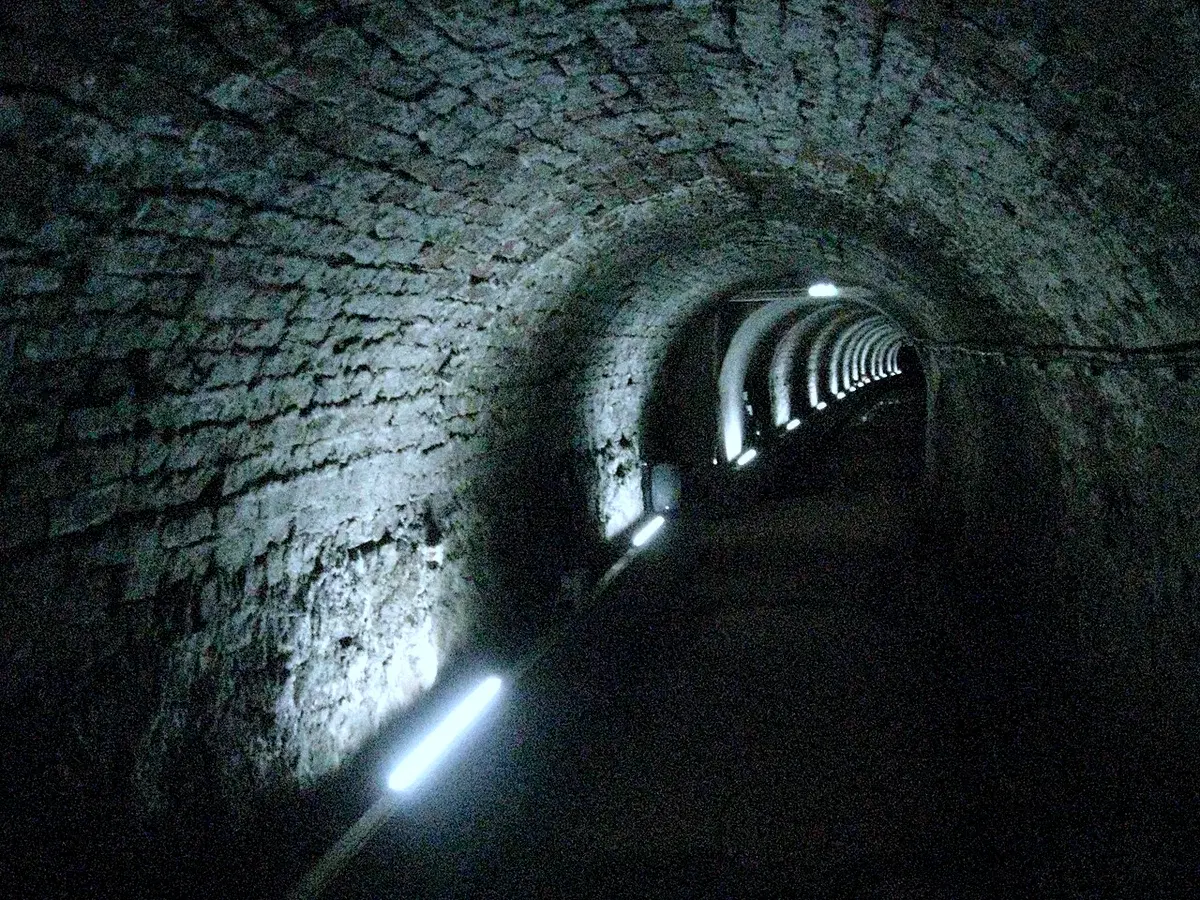
The Victoria Tunnel and the Town Moor
A 2.25-mile underground coal waggonway built in 1842, forced underground because the Freemen refused to allow tracks across the Town Moor. Later a WWII air raid shelter for 9,000 people.
The Victoria Tunnel exists because of the Town Moor. In 1838, the owners of Leazes Main Colliery at Spital Tongues needed to get their coal to the River Tyne. A surface waggonway was the obvious solution, but the Freemen of Newcastle refused permission for tracks to cross the Town Moor, protecting the common grazing land they had held since the 12th century. The result was one of the most remarkable feats of Victorian engineering in the North East: a 2.25-mile tunnel driven entirely underground.
Building the Tunnel
Work began in 1839 under engineer William Ellison Gillespie, a 27-year-old former employee of George and Robert Stephenson who had worked on the Liverpool and Manchester Railway. Around 200 navvies dug through boulder clay using a technique called clay kicking, lying on inclined boards at 45 degrees, using leather-aproned feet with sharpened iron spades to dislodge the earth.
Large boulders couldn't be broken out, so tunnellers navigated around them, which is why the tunnel isn't perfectly straight. An estimated 31,600 tons of boulder clay were hauled to the surface via temporary shafts, then processed into bricks used to line the tunnel itself.
The tunnel opened on 7 April 1842, named after Queen Victoria. It runs from Spital Tongues (on the southern fringe of the Town Moor) under Claremont Road, past the Hancock Museum, near the Civic Centre, under the Central Motorway, through Shieldfield, and down to the Ouseburn Valley. The gradient drops 222 feet from entrance to exit, coal wagons ran downhill by gravity, with horses hauling empty wagons back up. It reduced the cost of transporting coal from pit to river by 88%.
Tragically, Gillespie died in October 1846, aged just 33. The colliery itself closed in 1860 after only 18 years of operation.
WWII Air Raid Shelter
In 1939, Newcastle City Council converted the tunnel into an air raid shelter at a cost of £37,000. Seven new access points were added along the route, electric lighting was installed, and 500 bunk beds and wooden benches were fitted. Blast walls were erected inside to reduce bomb damage. The designed capacity was 9,000 people.
Dampness was a persistent problem that discouraged use. One Government inspector in 1941 reportedly observed: "better damp than dead." At the end of the war, all entrances except the one at Ouse Street were blocked up.
Visiting the Tunnel Today
The Ouseburn Trust has operated guided tours since 2010, after Newcastle City Council secured Heritage Lottery funding to restore a 766-yard section. Around 15,000 people take the tour each year.
Two tour lengths are available: a 1.25-hour standard tour (adults £13, children 7+ £6) and a 2-hour extended tour (£15/£6). Tours run Monday, Wednesday, Friday, Saturday, and Sunday, booking is mandatory in advance. From April 2026, an annual pass is included with every booking, allowing return visits throughout the year.
Meet at 51 Lime Street, Ouseburn (opposite Seven Stories). Book at ouseburntrust.org.uk or call 0191 261 6596.
The Town Moor
The Town Moor is the reason the tunnel exists, and it's a remarkable story in its own right. Covering approximately 1,000 acres of open common land (larger than Hyde Park and Hampstead Heath combined), it has been protected from development since an Act of Parliament in 1774.
The Freemen of Newcastle hold hereditary grazing rights, exercised from April to October each year. This ancient right, the same mechanism that forced the Victoria Tunnel underground, is the primary reason the Moor has never been built upon. The current governing legislation is the Newcastle upon Tyne Town Moor Act 1988.
The Moor has hosted horse racing (1721-1882), a Temperance Festival that drew an estimated 200,000 people in 1873, the Town Moor Aerodrome (from 1916), and today hosts the start of the Great North Run, a weekly parkrun, and The Hoppings, Europe's largest travelling funfair, held annually in the last week of June.
The Hoppings began in 1882 as a Temperance Fair, set up to provide an alternative to Race Week after horse racing moved to Gosforth Park. The name likely derives from the Middle English "hoppen", to dance, hop, or leap.
The Victoria Tunnel is one of Gosforth's most remarkable hidden stories. Book a tour to experience it for yourself, and next time you walk across the Town Moor, remember: beneath your feet, a Victorian coal tunnel runs for over two miles.
Never miss what’s on
Join the weekly Gosforth.org digest — the best events, news and local tips, straight to your inbox. Free, one email a week.
What's On
Kristy Cox Band + John Miller
7:30 PM · Gosforth Civic Theatre, Regent Farm Road, Gosforth, Newcastle upon Tyne, NE3 3HD
Sounds of the Underground: Bartholomew, the Cave
7:30 PM · Victoria Tunnel Entrance, Ouse Street, Newcastle
Floodlit Racing with Live Music, Newcastle Racecourse
See booking · Newcastle Racecourse, High Gosforth Park, Newcastle upon Tyne, NE3 5HP