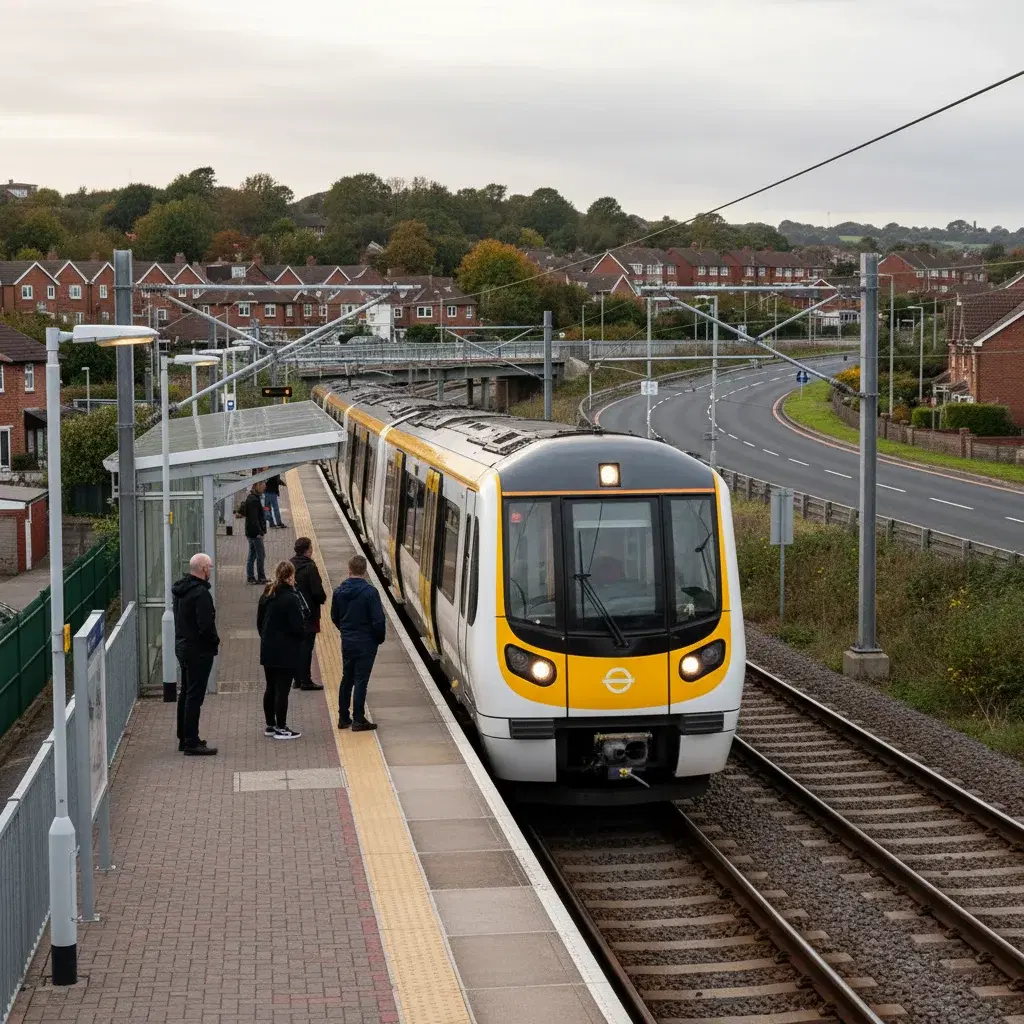
Gosforth's Railway Heritage
From the Blyth & Tyne Railway in 1864 to a brand-new £70 million Metro depot in 2024, Gosforth has been at the heart of North East rail for over 160 years.
Gosforth's relationship with the railway is deeper than most people realise. The suburb we know today was shaped by it, the Victorian expansion that created its tree-lined avenues, the Garden Village built for railway workers, the Metro that connects it to the city centre, and the depot that maintains every Metro train in the network. Here's the story.
The Blyth & Tyne Railway (1864)
Gosforth's railway era began on 27 June 1864 when the Blyth & Tyne Railway opened its extension through the area. A station opened at what was then simply called "Gosforth", later renamed South Gosforth in 1905. The Blyth & Tyne was absorbed into the North Eastern Railway (NER) in 1874, and the line became part of the North Tyneside Loop connecting Newcastle, the coast, and back again via South Gosforth.
The railway transformed Gosforth from a rural village into a commuter suburb. The grand Victorian and Edwardian villas along the tree-lined avenues, the ones that define the area today. Were built on the back of reliable rail connections to Newcastle city centre.
The Tyneside Electrics (1904)
On 29 March 1904, the NER opened one of Britain's first electric passenger services through South Gosforth, just one week after the Lancashire & Yorkshire Railway had electrified its Liverpool to Southport line. By 25 July 1904, the NER had created Britain's first all-electric suburban rail network, running at 600V DC third rail.
The consulting engineer was Charles Hesterman Merz, who lived at 54 High Street, Gosforth, a commemorative plaque was unveiled there in 2013. Merz was one of the great engineers of the age: he designed the Neptune Bank Power Station in Wallsend (the first three-phase electricity supply in Britain) and later sat on the committee that led to the creation of the National Grid.
Electrification was a direct response to tram competition, passengers had halved between 1901 and 1903. It worked: by 1913, passenger numbers had recovered past 10 million, and running costs fell to less than half the cost per mile of steam.
The original electric infrastructure lasted until 17 June 1967, when British Railways de-electrified the North Tyneside routes. Diesel trains took over, providing a slower, less frequent service, a decision that would drive the case for the Metro.
South Gosforth Depot
The story of the depot begins with a fire. In 1918, a blaze at Heaton carriage sheds destroyed 34 electric units. The NER acquired a replacement site at South Gosforth in 1921, and the new depot, with ten stabling roads plus two repair shop roads, opened in October 1923.
The depot has been the operational heart of electric traction in the North East ever since. It transferred to Tyne and Wear Metro operations in 1980, and between 2020 and 2024 was completely rebuilt in a £70 million reconstruction. The new 12-acre facility, completed in January 2024, features inspection roads, a wheel lathe building, wash plant, overhead cranes, and a modern control room. It maintains the entire Metro fleet and sits in the triangle of land between South Gosforth, Regent Centre, and Longbenton stations.
Garden Village (1920s)
The idea for Gosforth Garden Village was born in a boardroom meeting of the North Eastern Railway Company around 1909. On 5 April 1921, the NER purchased 64 acres for £18,500, land for both the housing and an extension to the carriage sheds.
By 1928, approximately 266 houses had been built in the garden village style, specifically for railway workers at the adjacent depot. The development was managed by LNER (Gosforth) Garden Village Ltd, a registered company formed in 1921. (The NER merged into the LNER at the 1923 Grouping, so the village was built under LNER stewardship.)
The village retains its distinctive character today, and the railway workers' heritage is documented by the Gosforth Garden Village Association.
West Gosforth and Regent Centre
The Gosforth and Ponteland Light Railway opened to passengers on 1 June 1905, with a station called West Gosforth on the site that is now Regent Centre. The Ponteland line never attracted many passengers, West Gosforth closed to passenger traffic on 17 June 1929, though freight continued for decades (industrial traffic to ICI Callerton and Rowntree's Fawdon).
In the late 1970s, the former Ponteland line was rebuilt for the Metro. Regent Centre Metro station opened on 10 May 1981, its platforms sit on the exact footprint of the 1905 West Gosforth station. The site was formerly the Regent Pit of Coxlodge Colliery, adding yet another layer of industrial history.
The Metro Conversion (1978–1981)
South Gosforth station closed on 23 January 1978 for conversion. All existing buildings were demolished except one: the original NER iron footbridge from 1864, which survives in daily use connecting the platforms today, recorded on the Tyne and Wear Historic Environment Record.
A substantial new building was constructed on the western side to house the Metro's Network Control Centre, making South Gosforth the operational nerve centre of the entire system. The station reopened on 11 August 1980. Regent Centre followed on 10 May 1981, restoring electric traction to Gosforth after the 14-year gap since de-electrification in 1967.
What Survives
Next time you pass through South Gosforth Metro station, look for the cast-iron NER footbridge. It's been there since 1864 and is the most significant surviving railway heritage structure in Gosforth. The triangular junction layout dates from the electrification era. The Metro line from South Gosforth to Regent Centre follows the earthworks of the 1905 Ponteland Railway. And the depot, rebuilt, but on the same site since 1923, continues to maintain every train on the network.
Gosforth's railway heritage stretches back over 160 years. If you have memories or photographs of the old stations, the electrics, or the depot, get in touch via our contact page.
Never miss what’s on
Join the weekly Gosforth.org digest — the best events, news and local tips, straight to your inbox. Free, one email a week.
What's On
Kristy Cox Band + John Miller
7:30 PM · Gosforth Civic Theatre, Regent Farm Road, Gosforth, Newcastle upon Tyne, NE3 3HD
Sounds of the Underground: Bartholomew, the Cave
7:30 PM · Victoria Tunnel Entrance, Ouse Street, Newcastle
Floodlit Racing with Live Music, Newcastle Racecourse
See booking · Newcastle Racecourse, High Gosforth Park, Newcastle upon Tyne, NE3 5HP