Heritage Walking Trail: A Self-Guided Walk Through Gosforth's History
A 5.5 km self-guided walking route linking nine historic landmarks, from a 12th-century church to a 1920s railway workers' estate. Allow two to three hours.
Gosforth's history stretches back over 850 years, but most of it is hiding in plain sight. The medieval church on the corner, the tiled pub on the High Street, the quiet estate behind the Metro depot -- each one has a story that most people walk past without knowing.
This self-guided trail links nine historic landmarks across a 5.5 km (3.4 mile) walking route. Allow two to three hours at a comfortable pace with stops to look around at each point. The route is entirely on pavements and tarmac paths, mostly flat, and accessible by pushchair. It works well as a weekend morning or afternoon walk, and several of the stops are pubs or near cafes if you want to break it up.
Before You Start
- Start point: All Saints Church, Church Road, NE3 1UP
- End point: Town Moor, Grandstand Road (or loop back to the High Street)
- Total distance: 5.5 km (3.4 miles)
- Estimated time: 2--3 hours including stops
- Terrain: Pavements and tarmac paths, mostly flat
- Facilities: Public toilets at Gosforth Shopping Centre; cafes and pubs throughout
Stop 1: All Saints Church
Address: Church Road, Gosforth, NE3 1UP | Distance to next stop: 400m
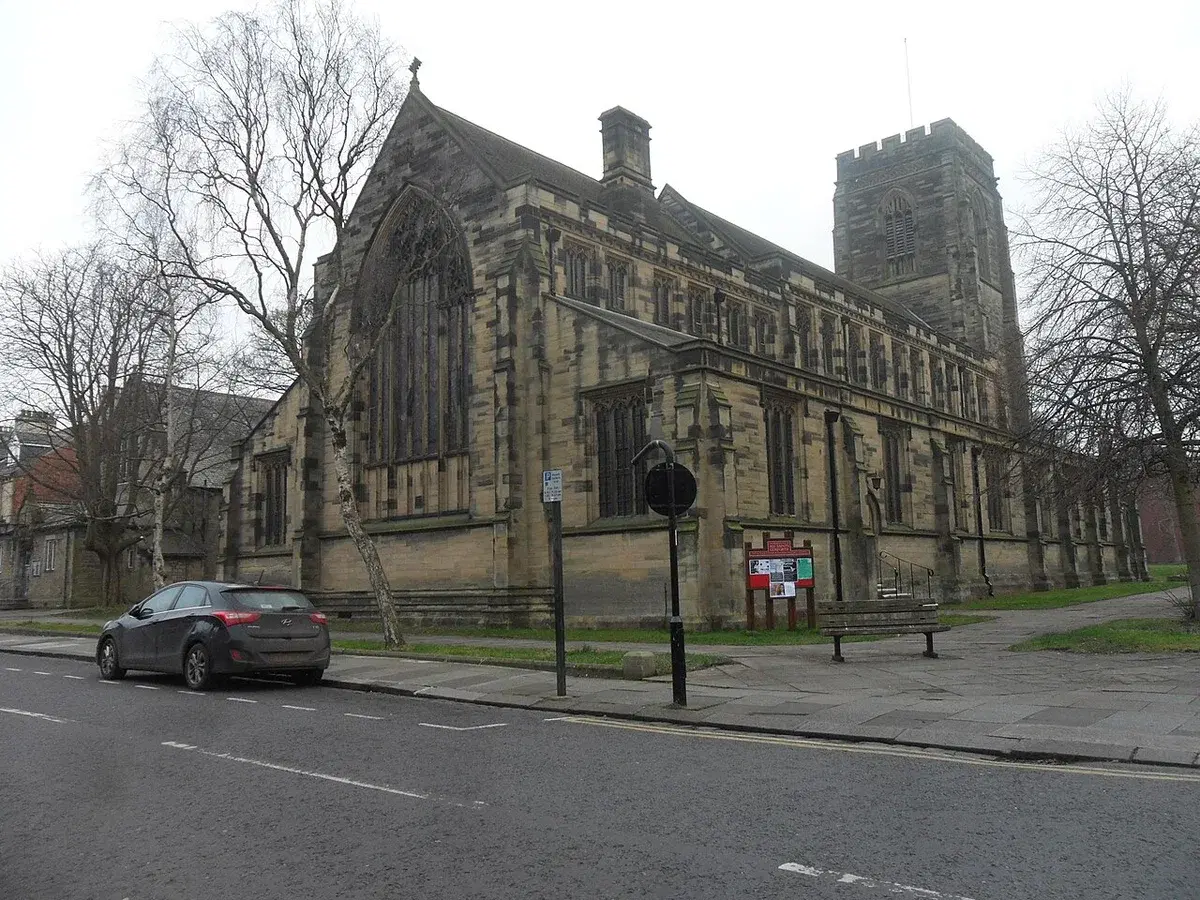
Founded in the 1170s during the reign of Henry II, All Saints Church is the oldest building in Gosforth and one of the oldest in Newcastle. The original Norman structure served scattered farming communities across the medieval township. The church you see today was largely rebuilt in 1887 by diocesan architect Robert J. Johnson in the Gothic Revival style, with the tower added in 1896.
The building is Grade I listed -- the highest level of heritage protection in England, shared with buildings like Westminster Abbey and York Minster. Only about 2.5% of listed buildings receive this status. The interior has Victorian wood carvings by Ralph Hedley, an organ by Harrison & Harrison, and stained glass windows depicting the saints throughout the ages.
The churchyard contains some of the oldest surviving structures in the Gosforth area. Mature trees, old headstones, and a peaceful atmosphere make it worth spending a few minutes here before moving on.
Best for: Grade I listed and over 850 years old, All Saints is the one building that connects modern Gosforth to its medieval origins.
Directions to Stop 2: Walk south along Church Road to the High Street. Turn right and head north along the High Street for approximately 300 metres.
Stop 2: The Gosforth Hotel
Address: 205 High Street, Gosforth, NE3 1HQ | Distance to next stop: 200m
The Gosforth Hotel was built in 1878 as Gosforth grew from a small settlement into a Victorian suburb. A buffet bar was added in 1891. In 1900 the property was bought by Arthur's Hill Brewery, and the exceptional tiled facade -- which still survives today -- was added in 1913.
Look carefully at the front of the building. The decorative tilework is one of the finest surviving examples on any Tyneside pub, and the reason the building is on the Local List of buildings of special local architectural or historic interest. The Gosforth Hotel has been serving pints on the High Street for nearly 150 years, making it one of the oldest continuously operating businesses in the area.
For much of its history, the High Street was the A1 -- the main road from London to Edinburgh. All north-south traffic passed directly through the centre of Gosforth, bringing trade, coaching inns, and a steady flow of travellers. It was not until 1988 that the western bypass relieved the High Street of through traffic.
Best for: The tiled facade dates from 1913 and is one of the finest surviving examples on any pub in the North East.
Directions to Stop 3: Continue north along the High Street for approximately 200 metres.
Stop 3: The Bulman Village Stone and High Street Heritage
Address: High Street, near the Brandling Arms, NE3 1HB | Distance to next stop: 150m
Gosforth's modern centre did not grow organically -- it was built deliberately. In 1826, a local figure called Job James Bulman built a settlement of properties on the Great North Road, large enough to qualify the occupiers as "forty shilling freeholders" and give them the right to vote. The purpose was to provide voters who would support his cause in local elections.
The settlement became known as Bulman Village. A stone bearing the name survives today, incorporated into the facade of what was the Halifax Bank building, north of the Brandling Arms. Look for it at around first-floor level.
While you are here, note the Brandling Arms itself. The pub is named after the Brandling family -- the dynasty that owned approximately 2,000 acres of Gosforth from 1509 to 1852, including the land that is now the racecourse, the nature reserve, and High Gosforth Park. Their story is one of the most remarkable in the area's history.
Best for: The Bulman Village stone is easy to miss. Look for it on the former bank facade, north of the Brandling Arms, at first-floor height.
Directions to Stop 4: Continue north along the High Street for approximately 150 metres.
Stop 4: The Former Tram Depot Site
Address: High Street, between Ivy Road and Woodbine Road, NE3 | Distance to next stop: 300m
One of the longest buildings on the High Street once stood here. Built in 1884, the tramway building ran from Ivy Road almost to Woodbine Road and originally housed three rows of stalls for 116 horses, a car shed, two manure stores, a harness room, a smithy, and a sawdust room.
The last horse-drawn tram ran on 13 April 1901; the first electric tram on 16 December 1901. Trams ceased altogether on 4 March 1950 after 49 years of electric service. The building was progressively converted -- first to a motor garage, then to Lipton's supermarket, then Presto, then KwikSave -- before being demolished in 1973.
Nothing of the original building survives, but this stretch of the High Street is where Gosforth's public transport story began. For more on the lost buildings of Gosforth, see our dedicated guide.
Best for: The tram sheds housed 116 horses and served both horse-drawn (from 1884) and electric trams (from 1901) before demolition in 1973.
Directions to Stop 5: Continue north along the High Street to 54 High Street, on the eastern side.
Stop 5: 54 High Street -- The Merz and McLellan Plaque
Address: 54 High Street, Gosforth, NE3 4AA | Distance to next stop: 600m
This unassuming building on the High Street was the home of Charles Hesterman Merz (1874--1940) and his business partner William McLellan (1874--1934), two of the most important engineers in British history. A commemorative plaque was unveiled here on 23 April 2013.
In 1904, Merz was the consulting engineer behind the electrification of the North Eastern Railway's suburban services through South Gosforth -- one of Britain's first electric passenger railways. By July 1904, the NER had created the country's first all-electric suburban rail network, running at 600V DC third rail. This was a direct response to tram competition, and it worked: passenger numbers recovered past 10 million by 1913.
Merz went on to design the Neptune Bank Power Station in Wallsend (the first three-phase electricity supply in Britain) and later sat on the committee that led to the creation of the National Grid. The firm of Merz and McLellan, founded in 1899, became one of the world's leading power engineering consultancies.
Best for: The man who lived at 54 High Street helped create the National Grid. Look for the commemorative plaque on the building's facade.
Directions to Stop 6: Head east from the High Street along Station Road towards South Gosforth Metro station. It is approximately a 600-metre walk.
Stop 6: South Gosforth Metro Station
Address: Station Road, South Gosforth, NE3 1QE | Distance to next stop: 400m
This junction has been at the heart of Gosforth's railway heritage for over 160 years. The station opened as "Gosforth" on 27 June 1864 on the Blyth and Tyne Railway, and was renamed South Gosforth in 1905. The railway transformed Gosforth from a rural village into a commuter suburb -- the grand Victorian and Edwardian villas along the tree-lined avenues were built on the back of reliable rail connections to Newcastle city centre.
The station closed on 23 January 1978 for conversion to the Tyne and Wear Metro. All existing buildings except the footbridge were demolished, and a substantial new building was constructed on the western side to house the Metro's network control centre. The station reopened as part of the Metro on 11 August 1980.
South Gosforth is where the Metro's coastal and airport lines converge, making it one of the most operationally important stations on the network. The adjacent depot -- rebuilt in a £70 million reconstruction completed in January 2024 -- maintains the entire Metro fleet.
Best for: South Gosforth has been a railway junction since 1864. The station's Victorian footbridge is the oldest surviving structure on the Metro network.
Directions to Stop 7: From the station, walk north along the streets into Garden Village. Head along Hawthorn Road or Rosewood Avenue into the estate. It is approximately a 400-metre walk.
Stop 7: Gosforth Garden Village
Address: Rosewood Avenue area, Gosforth, NE3 5DD | Distance to next stop: 800m
Tucked between the High Street and the Metro depot, Gosforth Garden Village is one of Newcastle's most distinctive residential areas. Built in the 1920s to house workers at the adjacent railway depot, it has a unique character that is immediately apparent as you walk through.
The story begins with a fire. In 1919, the Heaton Carriage Works burned down, and the North Eastern Railway Company needed a new depot. On 5 April 1921, the NER bought 64 acres for £18,500 for both the depot and housing. By 1928, the estate comprised 266 houses laid out on "garden suburb" lines -- a planned community with generous plots, green spaces, and a coherent design philosophy influenced by Ebenezer Howard's garden city ideals.
Walk along any of the estate's streets and the planned, uniform character is obvious -- modest but well-built semi-detached houses with pitched roofs and generous gardens. The Gosforth Garden Village Association has been active since the estate's earliest days and remains a genuine hub of community activity.
Best for: A planned 1920s railway workers' community that has survived intact for over 100 years -- with its original layout, many original houses, and a functioning residents' association.
Directions to Stop 8: Head west from Garden Village back towards the High Street, then continue south-west along the High Street to the Brandling Villa area. Alternatively, walk along Haddricks Mill Road. It is approximately 800 metres.
Stop 8: The Brandling Villa and Coxlodge Coach House
Address: Haddricks Mill Road, South Gosforth, NE3 1QL | Distance to next stop: 1.2 km
The Brandling Villa has been a public house since at least the 1880s and is first mentioned in the Northumberland Name Books in the 1860s as a "very neat public house." The two-storey sandstone building with three large bay windows may originally have been an opulent private residence -- perhaps connected to the Coxlodge Colliery that the Brandling family operated nearby.
A short detour along The Drive (off Elmfield Road, approximately 400 metres north-west) takes you to the Grade II listed Coach House and Stables of the former Coxlodge Hall. The hall itself was built in 1796 by Job Bulman -- the same family behind Bulman Village on the High Street. It was a substantial country house with nine bedrooms and approximately 30 acres of grounds, destroyed by fire in 1877, rebuilt, and finally demolished in 1939. The coach house and a lodge are all that survive, with the coach house recently converted into residential use.
The Job Bulman Wetherspoons on St Nicholas Avenue is named after the hall's original owner, and is housed in the former 1920s post office building -- another piece of Gosforth's architectural heritage.
Best for: The Brandling Villa makes a natural refreshment stop. The Grade II listed Coxlodge Coach House on The Drive is a short detour for those who want the full heritage experience.
Directions to Stop 9: Head south-west along Grandstand Road towards the Town Moor. It is approximately 1.2 km from the Brandling Villa.
Stop 9: The Town Moor and Hoppings Site
Address: Grandstand Road, NE3 | End of trail
The walk ends on the Town Moor -- approximately 1,000 acres of open common land, almost three times the size of Hyde Park, and protected from development since an Act of Parliament in 1774.
The Freemen of Newcastle hold hereditary grazing rights here, exercised from April to October each year. It was this ancient right that forced the builders of the Victoria Tunnel underground in 1842 -- the Freemen refused to allow coal waggonway tracks across the Moor, so a 2.25-mile tunnel was driven beneath it instead.
The Moor has hosted horse racing (1721--1882), a Temperance Festival that drew an estimated 200,000 people in 1873, and an aerodrome from 1916. Today it hosts the start of the Great North Run, a weekly parkrun, and The Hoppings -- Europe's largest travelling funfair, held annually in the last week of June. The Hoppings began on 28 June 1882 as the Newcastle Temperance Festival, and the name derives from the Middle English "hoppen" -- to dance, hop, or leap.
Grandstand Road itself takes its name from a permanent stone grandstand built in 1800 at the north end of the former racecourse. Racing moved to Gosforth Park in 1882, but the road name survives.
Best for: The Town Moor has been common land since the 12th century. The Freemen's grazing rights are the reason the Victoria Tunnel was built underground.
Route Summary
| Stop | Landmark | Key Date | Distance to Next |
|---|---|---|---|
| 1 | All Saints Church | 1170s | 400m |
| 2 | The Gosforth Hotel | 1878 | 200m |
| 3 | Bulman Village Stone | 1826 | 150m |
| 4 | Former Tram Depot | 1884 | 300m |
| 5 | 54 High Street (Merz plaque) | 1904 | 600m |
| 6 | South Gosforth Metro Station | 1864 | 400m |
| 7 | Gosforth Garden Village | 1920s | 800m |
| 8 | Brandling Villa / Coxlodge Coach House | 1880s / 1796 | 1.2 km |
| 9 | Town Moor / Hoppings Site | 1774 | -- |
Tips for the Walk
- Best time: A dry morning or afternoon. Allow extra time if you want to stop at the pubs along the route.
- Accessibility: The entire route is on pavements and tarmac. Mostly flat with gentle inclines only.
- Refreshments: The Gosforth Hotel (Stop 2), the Brandling Villa (Stop 8), and numerous cafes on the High Street.
- Extends well with: The Victoria Tunnel tour (book separately via the Ouseburn Trust) or the Town Moor parkrun on Saturday mornings.
- Related reading: The Brandling Family, Lost Buildings of Gosforth, Gosforth's Railway Heritage, The History of the High Street.
This trail covers over 850 years of history in a single walk. If you know of other heritage landmarks we should include, get in touch via the contact page.
Never miss what’s on
Join the weekly Gosforth.org digest — the best events, news and local tips, straight to your inbox. Free, one email a week.
What's On
Voices of Hope: 15 Years
7:30 PM · Trinity Church, Gosforth, Newcastle upon Tyne, NE3 4AG
Town Moor parkrun
9:00 AM · Town Moor, Newcastle upon Tyne
Mushroom Meander at Gosforth Nature Reserve
10:00 AM · Gosforth Nature Reserve, High Gosforth Park, Newcastle upon Tyne